Maharashtra is one of the major soybean-producing states in India, with Kharif cultivation contributing substantially to soybean production. Farmers look for varieties that offer good yield potential, have a suitable maturity period, provide resistance or tolerance to common crop stresses, and perform well under local growing conditions. Therefore, choosing the right soybean variety in Maharashtra can play an important role in improving crop performance and farm returns.
Among the available options, Yashoda-9041, Honey Badger, and KDS-992 (Phule Durva) offer different advantages for farmers in Maharashtra. Across these varieties, key attributes include earliness, drought or water-stress tolerance, disease tolerance, good grain quality, and high yield potential.
Which Soybean Variety Gives the Highest Yield in Maharashtra?
Soybean yield depends on several factors, including soil type, rainfall, sowing time, crop management, and weather conditions. However, Yashoda-9041, Honey Badger, and KDS-992 (Phule Durva) all have high-yielding characteristics and can be considered when selecting a soybean variety in Maharashtra.
Yashoda-9041 produces approximately 150–200 pods per plant, of which 25–30% are four-seeded pods. It is tolerant to water-stress conditions as well as YMV and stem fly, which improves its suitability for difficult cultivation conditions. Its seed rate is 25–30 kg/acre, while 100 seeds weigh approximately 17–18 grams.
Honey Badger produces pods at the top of the plant and grows to a height of approximately 2.5–3.5 feet. It has good resistance to both insect pests and diseases, as well as drought tolerance. Its seed rate is approximately 25–30 kg/acre, while 100 seeds weigh an average of approximately 15–17 grams. It has delivered good results, especially in the eastern and southern states.
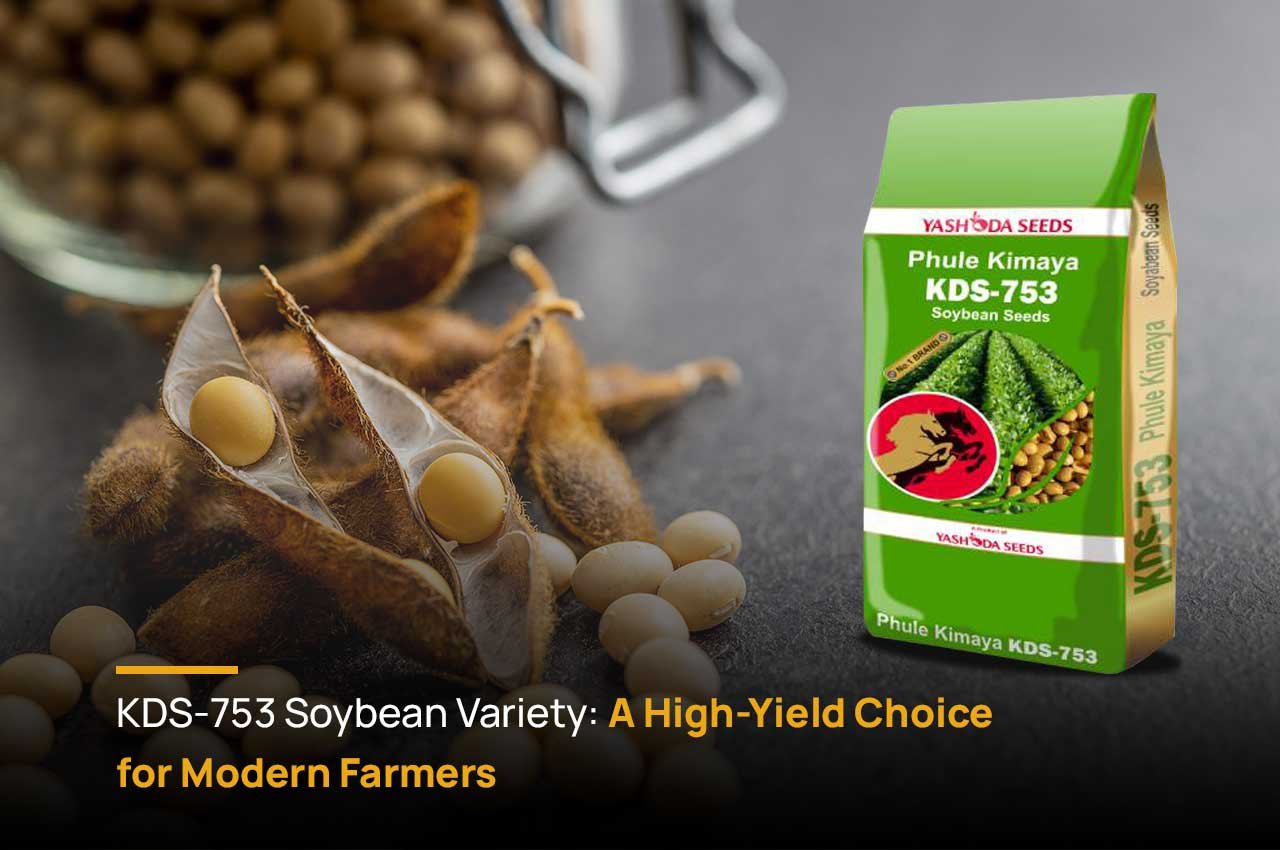
KDS-992, popularly known as Phule Durva, yields approximately 27–35 quintals per hectare. The variety produces large, bright golden-coloured grains and is usually grown in heavier soils. It is resistant to rust, purple seed stains, and bacterial pustule diseases. The variety has higher average grain weight, more branches, and greater yield potential.
Which Soybean Variety Is Best for Kharif Cultivation?
Soybean is primarily cultivated during the Kharif season. Therefore, selecting an appropriate variety becomes particularly important in regions where rainfall patterns can be uncertain.
Farmers may consider Yashoda-9041 as it is an early-maturing variety with the ability to withstand periods of moisture scarcity and is suitable for mechanised harvesting. It is also tolerant to pod shattering, which helps reduce losses during harvesting.
Honey Badger is another Kharif option that offers drought resistance and considerable resistance to insect pests and diseases. Its success in eastern and southern Indian states contributes to its acceptability in these regions.
KDS-992 (Phule Durva) can be selected by farmers looking to cultivate soybean in heavier soils and seeking a variety that produces bold, golden grains. It can be harvested in approximately 100–105 days and yields between 27 and 35 quintals per hectare.
What Are the Early-Maturing Soybean Varieties Suitable for Maharashtra?
Early maturity can be advantageous as it enables farmers to harvest the crop earlier and plan subsequent agricultural activities more effectively.
Among the three varieties, Yashoda-9041 is the earliest, taking approximately 85–95 days to mature. Its combination of early maturity, high yield potential, and tolerance to YMV and stem fly makes it an attractive soybean variety in Maharashtra.
Honey Badger takes approximately 90–95 days to mature, making it another early-maturing variety. In addition to its short duration, it offers drought tolerance and resistance to insect pests and diseases.
KDS-992 (Phule Durva) takes comparatively longer to mature, at approximately 100–105 days. Farmers can consider this variety when they wish to grow a longer-duration crop with bold grains.
These varieties, made available by Yashoda Hybrid Seeds, can help farmers choose a suitable option based on their soil, climate, and cultivation requirements.
What Is the Ideal Sowing Time for Soybean in Maharashtra?
Soybean is grown as a Kharif crop, which means its sowing time needs to coincide with the onset and establishment of the monsoon season. Therefore, soybean should be sown when the soil has received adequate moisture from the initial monsoon rains rather than solely according to calendar dates. Adequate soil moisture supports uniform seed germination and early crop establishment.
The exact sowing time can vary across Maharashtra depending on rainfall patterns, soil characteristics, and local agricultural advisories. Ensuring appropriate weather and soil moisture conditions can therefore contribute to better soybean sowing and crop establishment.
In addition to choosing the right sowing time, it is important to follow the recommended seed rate. For Yashoda-9041, Honey Badger, and KDS-992 (Phule Durva), the seed rate is 25–30 kg/acre.
Final Thoughts
Choosing the right soybean variety in Maharashtra depends on soil and growing conditions. Yashoda-9041, Honey Badger, and KDS-992 (Phule Durva) offer early maturity, stress tolerance, disease resistance, and high yield potential.
With suitable variety selection and crop management, Yashoda Hybrid Seeds supports diverse Kharif cultivation needs.
FAQs
Q. Which soybean variety matures the fastest?
Answer: Yashoda-9041 is the earliest among the three, with a maturity period of 85–95 days.
Q. Which soybean variety is suitable for drought-prone areas?
Answer: Yashoda-9041 and Honey Badger offer water-stress or drought tolerance, making them suitable for moisture-stressed conditions.
Q. Which soybean variety is suitable for mechanical harvesting?
Answer: Yashoda-9041 is tolerant to pod shattering and is suitable for mechanical harvesting.
Q. Which soybean variety performs well against pests and diseases?
Answer: Honey Badger has high tolerance to insect pests and diseases, while Yashoda-9041 is tolerant to YMV and stem flies.
Q. Which soybean variety has good water-stress tolerance?
Answer: Yashoda-9041 has water-stress tolerance, while Honey Badger is described as drought-tolerant.
Q. How many pods can Yashoda-9041 produce per plant?
Answer: Yashoda-9041 can produce approximately 150–200 pods per plant under suitable conditions.
 Blog
Blog
 login
login
 Cart
Cart 

 Field Crop
 Bengal Gram Seeds Hybrid Bajra Seeds Hybrid Cotton Seeds Hybrid Jowar Seeds Hybrid Maize Seeds Hybrid Paddy Seeds Notified Paddy Seeds Research Black Gram Seeds Research Green Seeds Research Paddy Seeds Research Tur Seeds Research Wheat Seeds Paddy Seeds Groundnut Seeds Notified Soybean Seeds Research Cowpea Seeds Research Soybean Seeds